Learn Russian Language for MBBS in Russia: Levels, Classes in Kerala and Medical Phrases
Lectures for Indian groups are in English, but patients, nurses and ward doctors in Russia speak Russian, so a medical student needs working Russian by the clinical years. This page shows what universities teach, what the levels A1, A2 and B1 mean in hours, where a student in Kerala can start learning Russian before departure, a 12-week plan, 30 medical phrases with pronunciation, and tips for Malayalam speakers.
In short: yes, learn Russian before you go. An English-medium group still meets Russian-speaking patients when the clinical years begin, in year 3 or 4 depending on the university. Universities teach Russian as a subject: the RUDN University 2026 plan for General Medicine lists a compulsory Russian course of 144 hours and an elective block of 720 hours. One university page puts A2 at 160 to 200 academic hours of guided study and B1 at 400 to 480. In Kerala you can start at the Russian House in Thiruvananthapuram, in the University of Kerala's Department of Russian, or online.
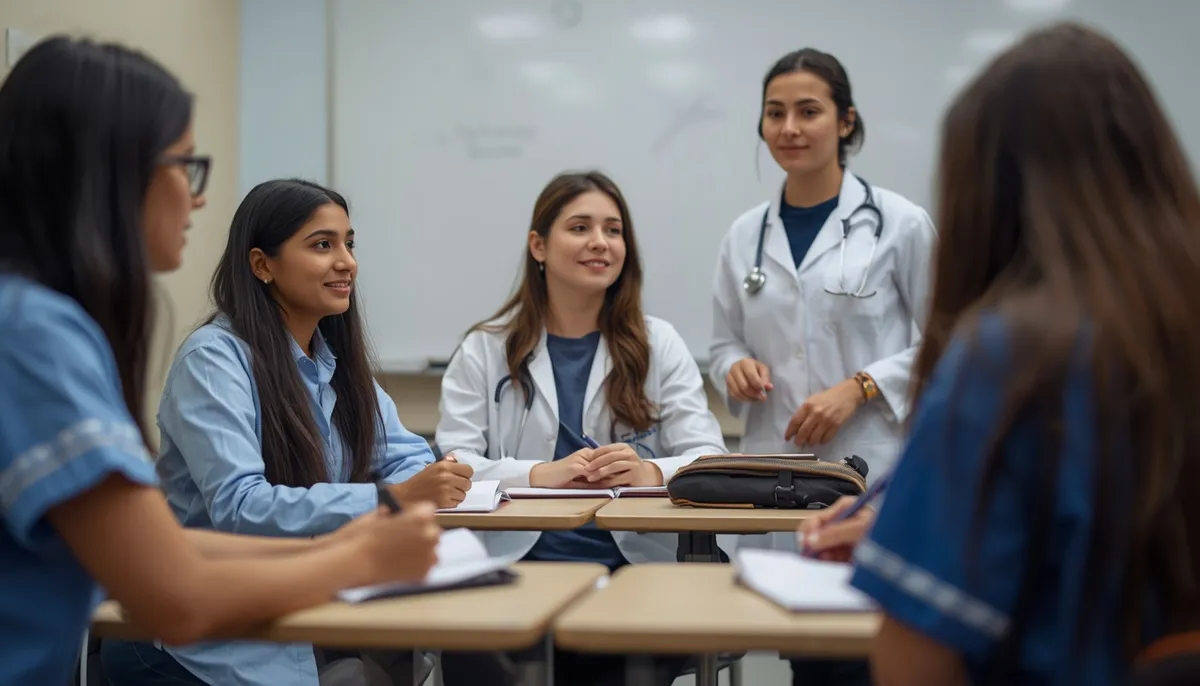
Do you need Russian for MBBS in Russia?
Yes, you need it, though not to get admission. The NMC rules require the course to be taught in English, so the lectures for Indian groups are in English and an English-medium admission letter does not depend on a Russian test. But a hospital is not a lecture hall. The patient who comes with chest pain describes it in Russian, the nurse writes the chart in Russian, and the consultant on the ward round often switches to Russian when the group is small. A student who cannot follow the history learns less from the same hours and gets less from the clinical exam.
The Ministry of External Affairs advisory for students in Russia, in an older text, warned that many institutions teach in English for the first three years and expect Russian from the fourth. Parents should treat that as a reason to ask questions, not to panic. Ask each university three things in writing: how many hours of Russian it teaches, in which semesters, and which clinical subjects are taught with Russian-speaking patients. Our MBBS subjects post shows when the clinical subjects start, and the university pages note what we could find on the language of each programme.
What Russian universities teach in the medical course
Every curriculum we read puts Russian as a foreign language in the first years. The clearest example is the RUDN University curriculum for General Medicine (specialty 31.05.01), 2026 intake, published in English and approved on 22 January 2026. It lists "Russian as a Foreign Language" as a compulsory discipline of 4 credits, which is 144 academic hours (one credit is 36 hours), and "Russian Language and Speech Culture" at 2 credits. It also lists "Russian Language for Foreign Students" at 20 credits, which is 720 hours. That 720-hour block sits under the heading of elective disciplines, so ask your university whether the Russian block for your group is compulsory or optional.
Other universities say the same thing in fewer words. The Bashkir State Medical University page for English-medium General Medicine says the programme has incorporated Russian language courses. Siberian State Medical University in Tomsk describes its medium as English with Russian language training for clinical practice; its programme page says the Russian lessons are optional, while the price order mentions additional study of Russian. The lesson for a family is the same each time: the English track is real, and Russian is the second track that makes the wards usable.
Russian levels A1, A2 and B1: what they mean and how many hours
Russian is tested on the same A1 to C2 scale as other European languages. The official Russian test, TRKI (in English TORFL, the Test of Russian as a Foreign Language), names the first levels Elementary (A1), Basic (A2), TRKI-1 (B1) and TRKI-2 (B2). For a medical student the realistic targets are these.
| Level | What you can do | Guided study, academic hours | Realistic target for MBBS |
|---|---|---|---|
| A1, Elementary | Read Cyrillic, greet, give your name, ask simple questions, understand slow speech on everyday topics | 60 to 80 | Before departure or in the first semester |
| A2, Basic | Handle shops, transport and hostel life; ask where it hurts and understand short answers | 160 to 200 | End of year 1 or year 2 |
| B1, TRKI-1 | Take a patient history with help, follow a ward round at normal speed with effort, read a short case | 400 to 480 | Before clinical rotations, year 3 |
| B2, TRKI-2 | Discuss a case, write notes and talk to patients without an interpreter | 560 to 680 | Useful by the final years, not needed on day one |
The hours are for guided classes. At 10 hours a week of real study (university class plus homework), 400 to 480 academic hours of 45 minutes, which is 300 to 360 clock hours, take roughly 30 to 36 weeks. A student who starts at home in Kerala and continues in the first year can therefore reach B1 around the end of year 2, in time for the wards, if the hour estimates hold. Students who wait for the clinical years to begin start with a deficit that is hard to close while also learning pathology and pharmacology.
The official test: TORFL (TRKI) and where to take it
A TRKI certificate is not part of the NMC conditions for an English-medium course, and an English-medium group does not need one to join. It is still the one document that proves your level. Each level has five subtests: vocabulary and grammar, reading, listening, writing and speaking, and the University of Victoria's test-centre page says a candidate must score at least 66% in each subtest to pass. Levels A1 and A2 take 3 hours 30 minutes, B1 takes 3 hours 50 minutes and B2 takes 4 hours 40 minutes, according to the same page.
Only authorised universities may issue state TRKI certificates. The Wikipedia article on TORFL says the Russian order No. 471 of 6 July 2019 lists 13 authorised organisations, including Saint Petersburg State University, Herzen University, Moscow State University, RUDN University and the Pushkin State Russian Language Institute. We found no listing of an authorised TRKI test centre in Kerala. The simple route is to sit the test in Russia, at your own university or a nearby authorised one, once you have a year of classes behind you; ask the international office which session dates they offer.
Russian language classes in Kerala: near me and online
Students searching for "Russian language classes near me" in Kerala have three kinds of options. We name what we could find and say how reliable it is, because course listings change every year.
- Russian House, Thiruvananthapuram. The Russian centre in the capital (also called the Russian Centre of Science and Culture) appears in directories at S. Roerich Road, Vanross Junction, University P.O., Thiruvananthapuram 695001, phone 0471 2338399, and has a Facebook page named Russian House Trivandrum. In 2023 Manorama Horizon ran a three-day online beginner course with the centre and Moscow State University of Education. We could not open the Russian government's own page for the centre from India, so the address and phone come from directory listings; call before you travel and ask whether a Russian course is running.
- University of Kerala, Department of Russian. The department runs a one-year Certificate course and an Integrated Diploma course in Russian, with morning and evening batches, according to the university notifications reported for 2026; the minimum qualification was Plus Two and the 2026 application deadline was 20 June 2026. The notifications are on keralauniversity.ac.in. Check the next intake there. It suits a student who finishes Class 12 early in the year and has several months before departure.
- Online tutors and apps. For Kochi, Kozhikode, Thrissur, Kannur and the districts without an in-person course we could verify, a one-to-one online teacher is the usual choice. Ask for a trial class, a teacher who has taught foreign students of medicine, and a plan that includes speaking from the first week. A mainstream language app with a Russian course helps with the alphabet and vocabulary, but it does not replace a speaking teacher.
We do not teach Russian ourselves and do not recommend one paid teacher over another. Ask your shortlisted university whether it offers a pre-arrival online Russian course, and for its hours and schedule. Do not pay a long-term package for a teacher you have not tried.
Ask us about Russian lessons and universities
Tell us your university shortlist; we check how many Russian hours each one teaches and when clinical rotations begin.
A 12-week plan before departure
Many Kerala students have a gap of a few months between the NEET result and the flight. Twelve weeks at about 7 hours a week is 84 hours, which is in the range sources give for the A1 level of guided study. Self-study is less efficient than a classroom, so expect solid A1 and a start on A2, not B1.
| Weeks | Focus | What you should be able to do |
|---|---|---|
| 1 to 2 | The Cyrillic alphabet (33 letters), sounds, reading aloud | Read any word slowly; write your name and your city in Cyrillic |
| 3 to 4 | Greetings, introductions, numbers to 100, time and dates | Introduce yourself and say your age, course and city in Russian |
| 5 to 6 | Body parts and symptoms, "where does it hurt" | Name 30 body parts and ask a patient where the pain is |
| 7 to 8 | History-taking questions from the phrase table below; first cases (nominative, accusative, genitive) | Ask the 10 standard questions of a history and understand short replies |
| 9 to 10 | Daily life: food, shopping, transport, the hostel, the pharmacy | Buy a ticket, order food and ask for a medicine |
| 11 to 12 | Listening to slow Russian, role-play of a 5-minute patient interview, revision | Hold a short conversation and recognise most words in slow speech |
Pairing with a friend who is also joining a Russian university helps, because speaking practice is the part a book cannot give. For the rest of the preparation, the MBBS in Russia admission 2027 page lists the admission calendar and documents, and the admission process page shows the order of steps.
Medical Russian: 30 useful phrases
These are the questions and instructions a student hears and says on ward rounds, with a simple pronunciation guide. The stress is marked with an accent in the pronunciation column; in Russian the stressed syllable is said longer and louder, and the other vowels become weak. "Ya ne ponyál" is said by a man, "ya ne ponyalá" by a woman.
| English | Russian | Say it like |
|---|---|---|
| Hello (formal, to a patient or teacher) | Здравствуйте | zdrást-vuy-te |
| I am a medical student | Я студент-медик / студентка-медик | ya studént-medík / studéntka-medík |
| What is your name? | Как вас зовут? | kak vas zovút |
| What is troubling you? | Что вас беспокоит? | shto vas bespokóit |
| Where does it hurt? | Где болит? | gdye bolít |
| Please show me | Покажите, пожалуйста | pokazhíte, pozháluysta |
| How long ago did it start? | Как давно это началось? | kak davnó éto nachalós' |
| Is the pain sharp or dull? | Боль острая или тупая? | bol' óstraya íli túpaya |
| Do you have a fever? | У вас есть температура? | u vas yest' temperatúra |
| Are you allergic to any medicine? | У вас есть аллергия на лекарства? | u vas yest' allérgiya na lekárstva |
| Are you taking any medicines? | Вы принимаете какие-нибудь лекарства? | vy prinimáyete kakíye-nibud' lekárstva |
| Breathe deeply | Дышите глубоко | dýshite glubokó |
| Hold your breath | Не дышите | ne dýshite |
| Open your mouth | Откройте рот | otkróyte rot |
| Give me your hand | Дайте руку | dáyte rúku |
| I will measure your blood pressure | Я измерю вам давление | ya izmeryú vam davlyéniye |
| Please lie down | Лягте, пожалуйста | lyágte, pozháluysta |
| Please sit down | Сядьте, пожалуйста | syád'te, pozháluysta |
| Undress to the waist | Разденьтесь до пояса | razdén'tes' do póyasa |
| It does not hurt | Это не больно | éto ne ból'no |
| You need a blood test | Вам нужно сдать анализ крови | vam núzhno sdat' análiz króvi |
| You need an X-ray | Вам нужно сделать рентген | vam núzhno sdyélat' rentgyén |
| Take one tablet three times a day | Принимайте по одной таблетке три раза в день | prinimáyte po odnóy tablétke tri ráza v den' |
| Take it after meals | Принимайте после еды | prinimáyte pósle yedý |
| Do you understand me? | Вы меня понимаете? | vy menyá ponimáyete |
| Please repeat | Повторите, пожалуйста | povtoríte, pozháluysta |
| Please speak more slowly | Говорите медленнее, пожалуйста | govoríte médlennee, pozháluysta |
| I did not understand (man / woman) | Я не понял / Я не поняла | ya ne ponyál / ya ne ponyalá |
| How do you say this in Russian? | Как это по-русски? | kak éto po-rússki |
| I will call the doctor | Я позову врача | ya pozovú vrachá |
Learn the phrases in pairs: the question and the answer you expect. "Где болит?" is only useful if you can also understand "здесь" (here), "в груди" (in the chest) and "в животе" (in the stomach). Record yourself, play it back, and ask a teacher to mark the stress, because a wrong stress is the commonest reason a Russian listener does not understand a foreigner.
Pronunciation tips for Malayalam speakers
Malayalam speakers start with real advantages. Malayalam has a rolled r (റ്) like Russian р, case endings on nouns like Russian, no articles, and no "am, is, are" in the present tense, so "Я врач" (I am a doctor) will feel natural. These are the points that need attention.
- Dental т and д. Russian т and д are dental, like Malayalam ത and ദ. Do not use the retroflex ട and ഡ that Indian English uses for "t" and "d".
- No extra puff. Russian п, т, к are said without the breath of aspirated sounds. Say them as in Malayalam പ, ത, ക, and do not copy English-style puffs.
- Weak vowels. In Russian an unstressed о sounds like a short "a": молоко (milk) is said "malakó". Malayalam gives every vowel its full length, so listen for the stress and shorten the other vowels.
- The sound ы. Say "i" as in "bit" with the tongue pulled back and the lips spread. Practise with мы (we) and вы (you). Malayalam has no exact equivalent.
- ж, ш and х. ж is the "s" of "measure"; ш is "sh". The Malayalam ഴ is a different sound, so do not substitute it for ж. х is a rough h made at the back of the mouth, not the aspirated ഖ.
- Soft consonants. A consonant followed by ь, я, е, ё, ю or и is said with the tongue raised to the palate. The "ny" of "canyon" is close to нь. The difference changes the meaning: брат (brother) and брать (to take).
- Do not add vowels in clusters. Say здравствуйте as one word, "zdrást-vuy-te", without a vowel inside the first cluster.
After you arrive: keep the habit
Use the compulsory Russian class as a minimum, not a target. Ask the Russian teacher for the medical vocabulary in the first year, speak Russian in the hostel and the shop, and ask the Malayali seniors in your university for their notes. The Malayali student life post covers food, Onam and the support available abroad. Aim for A2 by the end of year 1 or 2 and B1 before the first patient rotation, and ask your teacher for a mock TRKI test at that point.
Language also matters at the end of the course. Our FMGE exam guide notes that clinical subjects carry 200 of the 300 marks, and a student who followed the ward rounds finds them easier. The right time to compare universities on language is before you pay, so use the university list to shortlist and ask each international office the three questions above.
Not sure how much Russian your university teaches?
Send your shortlist and NEET score; we ask each university for its Russian hours and clinical start in writing.
Learn Russian for MBBS: Frequently Asked Questions
Do I need to know Russian for MBBS in Russia?
You do not need a Russian certificate to join an English-medium group, but you need Russian for the clinical years. Patients and nurses speak Russian, and the universities teach Russian as a subject for this reason. Start before departure and continue in the first year.
How long does it take to learn enough Russian for the wards?
A university page quotes 160 to 200 academic hours of guided study for A2 and 400 to 480 for B1. At 10 hours a week, B1 takes roughly 30 to 36 weeks. A student who studies from the first semester can reach B1 around the end of year 2 if the estimate holds.
Where can I find Russian language classes near me in Kerala?
The Russian House in Thiruvananthapuram and the University of Kerala's Department of Russian are the two in-person options we could find; check their current courses before you plan. For other districts, an online teacher is the usual choice. Ask for a trial class first.
Can I learn Russian online before leaving Kerala?
Yes. Use a one-to-one teacher for speaking and a mainstream language app for the alphabet and vocabulary. A plan of about 7 hours a week for 12 weeks gives a good start on A1 and the first words of medical Russian.
Is the TORFL or TRKI certificate compulsory for MBBS?
It is not among the NMC conditions for a foreign medical course, which require teaching in English. A university may set its own language test or placement exam, so ask for the language rules in your admission letter. Only authorised universities in Russia can issue the state certificate.
What if I reach Russia without knowing any Russian?
You can still start, because the universities teach Russian from the first semester; the RUDN plan lists a compulsory 144-hour course. But you will spend the first months on survival Russian, and a head start of even 12 weeks makes shopping, the hostel and the first classes easier.
Sources: RUDN University, curriculum "General Medicine" 31.05.01, 2026 intake, English version (rudn.ru/sveden), disciplines Б1.О.01, Б1.В.01 and ФТД.В.03; Bashkir State Medical University, English-medium General Medicine page (bashgmu.ru, read through a search summary only); Siberian State Medical University (Tomsk) programme page and price order, as recorded in our data; Ministry of External Affairs, advisory for Indian students going abroad: Russian Federation (older text); Omsk State Pedagogical University, TRKI level descriptions (omgpu.ru, read through a search summary only); educalanguageschool.com, Russian language proficiency levels; University of Victoria Russian Language Test Centre, TORFL page; Wikipedia, "TORFL" (order No. 471 of 6 July 2019); Manorama Online, Horizon, Russian House course notice of 28 May 2023; directory listings and Facebook page of Russian House Trivandrum; University of Kerala, Department of Russian notifications 2026 (keralauniversity.ac.in, read through search summaries only); NMC Foreign Medical Graduate Licentiate Regulations 2021. Checked 15 October 2026.