How to Become a Dermatologist After 12th: MD Route, Years, Cost and Seats
To become a dermatologist you need an MBBS and then a 3-year postgraduate degree in Dermatology, Venereology and Leprosy, won through NEET-PG. That is at least 8.5 years after Class 12 with an Indian MBBS and 10 years with an MBBS from Russia. This guide gives the exams, the years, the Kerala fees we could source and the real competition for a skin-speciality seat, and explains why a cosmetologist is not a dermatologist.
In short: a dermatologist is an MBBS doctor with a postgraduate degree: MD in Dermatology, Venereology and Leprosy (3 years), a DNB in the same subject (3 years) or, on the older pattern, a 2-year diploma. The seat is allotted by your NEET-PG rank. Minimum time after Class 12: 5.5 years of MBBS and internship plus 3 years of MD is 8.5 years in India. With a Russian MBBS it is 6 years in Russia, 1 year of internship in India and 3 years of MD, which is 10 years, if FMGE and NEET-PG go right the first time. The NMC seat matrix for 2026-27 lists 1,880 MD Dermatology seats against 63,177 postgraduate seats of all kinds, about 3%. A cosmetologist with a beauty-therapy diploma is not a dermatologist, and a diploma or fellowship in cosmetology does not replace the MD.
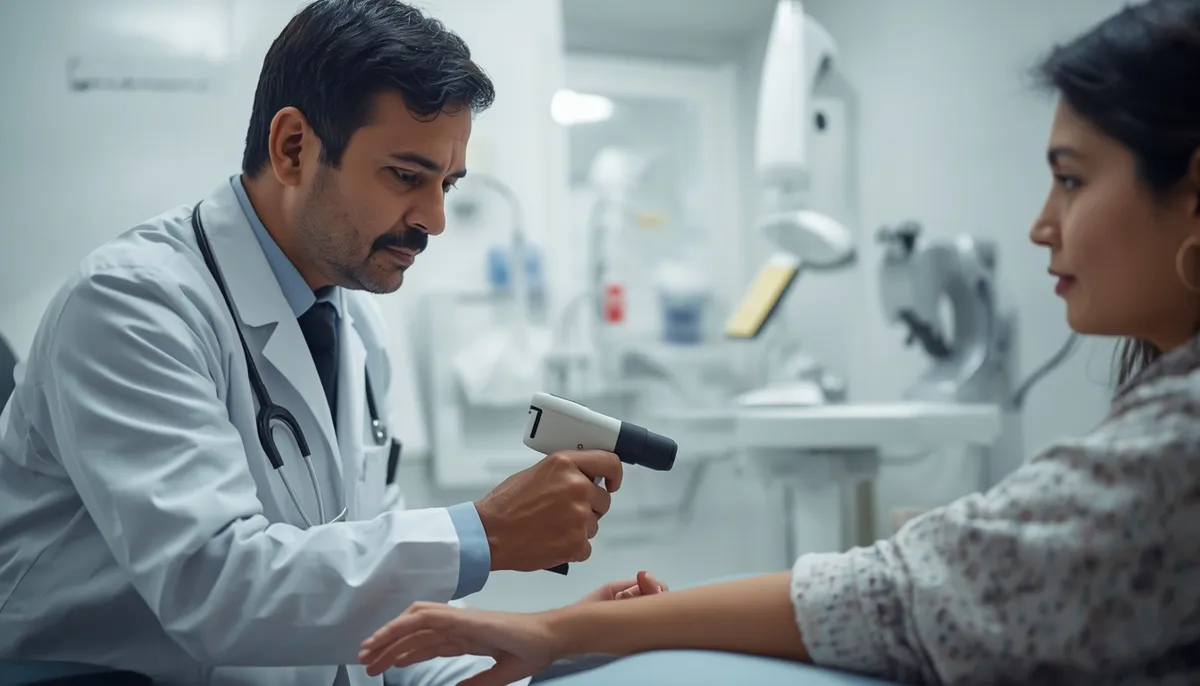
How to become a dermatologist after 12th: six steps
"How do I become a dermatologist?" has one answer for every student, whether the MBBS is done in Kerala, elsewhere in India or in Russia. You cannot skip a step, and each step has its own exam. Here is the order, with the time each step adds and the running total after Class 12.
Class 12 with Physics, Chemistry and Biology
You need 50% marks in PCB (40% for reserved categories) and an age of 17 by 31 December of the admission year. Nothing about dermatology is decided here.
NEET-UG
The NEET-UG 2026 qualifying mark was 213/720 for general and EWS (144 in 2025), 194 for general PwBD and 177 for SC/ST/OBC. The exam of 3 May 2026 was cancelled after a paper leak and re-held on 21 June, and the result came on 16 July 2026. Qualifying is enough to join a Russian university. For a Kerala government seat you need a high rank; see NEET 2026 result: what next.
MBBS
In India the MBBS is 4.5 years plus a 12-month internship. In Russia it is 6 years, including the 12-month internship at the same university, under the NMC Foreign Medical Graduate Licentiate Regulations 2021 (at least 54 months in English).
FMGE and the internship in India (Russian graduates only)
A graduate from Russia passes FMGE, then does a 12-month internship in an Indian hospital and registers with the state medical council. See what happens after MBBS in Russia.
NEET-PG
NBEMS holds NEET-PG once a year. For 2026 it was held on 30 August, and the internship cut-off date was 30 September 2026, as Careers360 reported. 2,65,960 candidates appeared and the result came on 24 September 2026. The qualifying score was 262 out of 800 for general and EWS. Your rank decides whether you get dermatology and in which college.
MD in Dermatology, Venereology and Leprosy
The degree takes 3 years. After it you are a specialist and can be registered as one.
| Stage | Time | Total after Class 12: Indian MBBS | Total after Class 12: Russian MBBS |
|---|---|---|---|
| MBBS with internship | 5.5 years in India, 6 years in Russia | 5.5 | 6 |
| Internship in India after FMGE | 1 year | not needed | 7 |
| MD in Dermatology, Venereology and Leprosy | 3 years | 8.5 | 10 |
Real careers run longer. FMGE has three sessions a year since 2026, but a student who misses a session, or who waits for the NEET-PG date after the internship, loses months. We found no published figure for the average gap, so plan with a margin. A student who starts at 17 or 18 can be a dermatologist at about 26 with an Indian MBBS and about 27 or 28 with a Russian one.
MD, DNB or diploma: which degree makes a dermatologist
The NMC's Post-Graduate Medical Education Regulations 2023 give three postgraduate options in this subject, and the course names are worth knowing because parents hear all of them.
| Qualification | Length | How you enter | Note |
|---|---|---|---|
| MD (Dermatology, Venereology and Leprosy) | 3 years | NEET-PG rank and MCC or state counselling | The standard degree. The regulations cut it to 2 years for a student who already holds a recognised 2-year diploma in the same subject. |
| DNB (Dermatology, Venereology and Leprosy) | 3 years | NEET-PG counselling for seats in NBEMS-accredited hospitals | Awarded by NBEMS, not a university. Kerala PSC notices for faculty posts accept MD or DNB, but check each notice. |
| Diploma (DDVL) | 2 years | NEET-PG counselling | The regulations say no new applications are accepted to start or increase diploma seats. The NMC matrix for 2026-27 lists only 15 DDVL seats. |
The MD is the one most families should plan for. A diploma seat is now rare, and the few that exist are filled by the highest ranks only if they are in good colleges. The regulations also say that after the MD or DNB you can add a post-doctoral fellowship of 2 years or a one-year certificate course, but they list no fellowship called cosmetology, as the next section explains.
Want a dermatologist's route costed for your family?
Send your NEET score and category; we send the years, the exams and the money needed at each step, for India and for Russia.
Cosmetologist vs dermatologist: why the difference matters
Many students searching for a "cosmetology course" are really asking how to become a skin doctor. The two careers sit on opposite sides of an MBBS.
| Dermatologist | Cosmetic dermatologist | Cosmetologist (beauty therapist) | |
|---|---|---|---|
| Basic qualification | MBBS | MBBS | Class 12 or a short certificate or diploma; the courses we saw do not ask for MBBS, but check each prospectus |
| Postgraduate degree | MD or DNB in Dermatology, Venereology and Leprosy, or a diploma | The same MD or DNB, then extra training in lasers, fillers and similar procedures | None |
| Registered doctor | Yes, with the state medical council | Yes | No |
| Treats disease | Yes: skin, hair and nail disease, infections, leprosy | Yes, plus cosmetic procedures | No; grooming and beauty services |
The practical rule for parents: look at the name board and the registration number. A doctor who treats skin disease should hold MBBS and be on the state medical council's register. In the notices we read for Kerala that council is the Travancore-Cochin Medical Council, and one NHM notice names the Council of Modern Medicine Kerala. A "diploma in cosmetology" from a private institute can be a fine qualification for a beauty-therapy career, but it does not make you a doctor and it does not replace an MD. If a clinic that offers injections or laser treatment cannot show a medical degree and registration, do not book.
A student who wants cosmetic work as a doctor takes the long route: MBBS, MD in Dermatology, then a fellowship or certificate in cosmetic dermatology or dermatosurgery. Some fellowships are run by dermatology societies after the MD. We did not verify the length or fees of any one fellowship, so ask the institute and check that it requires an MD.
Can I become a dermatologist after BAMS, BDS or without NEET?
No. An MD, DNB or diploma seat is a postgraduate medical seat allotted by NEET-PG, and NEET-PG is for doctors with an MBBS. A BAMS or BDS graduate has other postgraduate courses in Ayurveda or dentistry, but neither degree leads to an MD in Dermatology, Venereology and Leprosy. Without NEET you also cannot start the MBBS: NEET-UG is compulsory for Indian students whether they study in India or in Russia.
What a dermatologist treats
The subject name explains the job: Dermatology, Venereology and Leprosy. A dermatologist treats skin, hair and nail diseases such as eczema, psoriasis, acne, fungal infections and allergies. Venereology covers sexually transmitted infections, and leprosy care is part of the MD syllabus because of India's disease burden. Many dermatologists then add cosmetic procedures, hair treatments, laser work or skin surgery, and some focus on children or on hair disorders. Much of the work is in outpatient clinics rather than night emergencies, but that is a general observation, not a rule for every post.
How hard is the seat: competition for MD dermatology
The step that decides everything is NEET-PG. The NMC's seat matrix for 2026-27, as on 29 September 2026 and reported by Medical Dialogues, lists 63,177 MD, MS, diploma, DM and MCh seats in India. Of these, 1,880 are in MD Dermatology, Venereology and Leprosy and 15 in the DDVL diploma. MD General Medicine alone has 6,143 seats, more than three times as many. A seat in dermatology therefore goes to a small share of the 2,65,960 candidates who appeared in 2026, and the share that clears the qualifying score of 262 is much larger than the share that gets a skin seat.
Third-party sites that compile the MCC allotment lists, such as Sartha, show the 2025 all-India-quota closing rank for MD Dermatology (general category) at about 2,700 in the first round and about 15,100 over all rounds. These are not official figures. The MCC publishes the allotment lists on mcc.nic.in, and the closing rank changes every year and with the college. The honest summary is that dermatology is among the more sought-after broad specialities, so a good NEET-PG rank matters more here than in several other branches, and a government college in Kerala needs a higher rank than a private seat.
Students from Russia compete in the same list as Indian graduates once they have passed FMGE and finished the internship. The MD does not record where the MBBS was done. What differs is the time and the FMGE risk: Russian graduates passed at about 25% over 2022 to 2025 combined, 18.1% in June 2025 and 30.9% in December 2025. See the FMGE pass rate by university before you choose.
How much it costs to become a dermatologist in Kerala
Most of the cost sits in the MBBS and, if you take a self-financing postgraduate seat, in the MD. The official figures we could source are below. The MD fees are from the Kerala orders for 2023-24 and the prospectus for 2024-25; later revisions may exist.
| Stage | Fee | Source and note |
|---|---|---|
| MBBS, Kerala government college | about ₹23,150 a year | Tuition only |
| MBBS, Kerala self-financing college | about ₹8.1 lakh a year | One college's 2025-26 provisional fee was ₹8,10,175 |
| MBBS, Russian state university | ₹2.4 lakh to ₹14.1 lakh a year | First-year tuition from price orders, six years of study; see fees in Russia |
| FMGE (October 2026 session) | ₹4,650 | NBEMS bulletin; each attempt |
| MD, Kerala government college | ₹57,890 tuition a year | Plus ₹11,580 miscellaneous fee a year and a refundable deposit of ₹11,580; the first payment is ₹81,050 (Kerala G.O.(Ms) No. 92/2023/H&FWD, quoted in the CEE Kerala prospectus) |
| MD, Kerala self-financing college | ₹17,61,665 a year | Fee order for 2023-24 as reported by Onmanorama; the NRI-quota fee is ₹37,01,600 a year. The report groups MD, MS and super-speciality seats |
Two cases for the MD alone, tuition only, at those fees. A government seat for 3 years is 3 × ₹57,890, which is ₹1,73,670. A self-financing seat for 3 years is 3 × ₹17,61,665, which is ₹52,84,995, about ₹52.8 lakh. Add the MBBS: for a Russian MBBS, six times the yearly price in the table, plus living costs, flights and each FMGE attempt. Our fee table shows every university, and the education loan guide explains what a bank will finance. Size a loan for the MBBS, not for a hoped-for self-financing MD seat.
Two conditions come with a Kerala government PG seat. The 2024-25 prospectus asks the student to sign two bonds on ₹200 stamp paper, and general-merit and all-India-quota candidates must serve the Government of Kerala as a Senior Resident for at least one year after the course. A candidate who vacates a seat after the stray vacancy phase is liable to pay ₹50,00,000 as liquidated damages. Read the prospectus for the year you apply, because the terms can change.
Stipend during the MD
A PG student is also a working resident and is paid. The NMC regulations say that stipend in every institution must be at par with the stipend in government medical institutions in the same state. Kerala Kaumudi reported in July 2026 that the present monthly stipend for the three years of PG in Kerala government colleges is ₹57,900, ₹58,900 and ₹60,000, and that a promised revision was pending. That adds up to ₹21,21,600, about ₹21.2 lakh, over three years. The last Kerala order we could trace, G.O.(Ms) No. 101/2019/H&FWD effective 1 July 2019, set ₹53,000, ₹54,000 and ₹55,000 for the three years, as quoted in an NBEMS notice. Ask the college for the current amount before you accept a seat. The stipend does not cover the MBBS years or a gap year, but over the MD it can be larger than the tuition of a government seat.
Get a dermatology plan for the next 10 years
Tell us your NEET score and whether you prefer India or Russia; we reply with the exams, the years and the budget in order.
Dermatologist salary in Kerala
We found no reliable published figure for private clinics or for cosmetic practice, which is where many dermatologists earn most, and we do not quote one. What the official documents show for government jobs is below. The scales are from the Kerala 11th Pay Revision order, G.O.(P) No. 27/2021/Fin dated 10 February 2021, which applies from 1 July 2019 and is the scale still used in Kerala PSC notices in 2025. A specialist in the Health Services Department is placed in the "specialist cadre", and the order does not name dermatology separately.
| Post (Health Services, Kerala) | Pay scale a month | Special pay a month |
|---|---|---|
| Assistant Surgeon (MBBS only) | ₹63,700–1,23,700 | none |
| Junior Consultant (specialist) | ₹63,700–1,23,700 | ₹9,900 |
| Consultant | ₹95,600–1,53,200 | ₹14,700 |
| Senior Consultant | ₹1,18,100–1,63,400 | ₹16,800 |
A doctor who joins as a Junior Consultant at the bottom therefore starts at ₹63,700 plus ₹9,900, which is ₹73,600 a month before allowances. Teaching posts in medical colleges are on UGC pattern pay, and Kerala PSC notices for them give no rupee amount. NHM Kerala offered ₹78,000 a month, consolidated, for a contract specialist in surgery or cardiology in Kollam in October 2025; we found no NHM notice for dermatology. The full picture, with the MBBS-only posts and the 12th Pay Revision Commission status, is in doctor salary after MBBS from Russia.
If you choose Russia for the MBBS
- Pick a university by its FMGE record, because the first gate to a dermatology seat is FMGE and the Indian internship.
- Check that the course meets the NMC rules: at least 54 months in English, a 12-month internship at the same university and a licence to practise in Russia. See the NMC rules for foreign medical graduates.
- Study for NEET-PG from the final years. It tests the Indian MBBS syllabus, and dermatology is chosen by rank at counselling, not at admission.
- Keep the internship dates in mind. NBEMS sets an internship cut-off date every year, and in 2026 it was 30 September.
Other specialities have different routes and years. See how to become a cardiologist, a neurologist, a surgeon and a gynecologist.
Not sure Russia or India is right for your child?
Send your NEET score and budget; a counsellor who speaks Malayalam replies on WhatsApp.
How to Become a Dermatologist: Frequently Asked Questions
How do I become a dermatologist after 12th?
Study PCB in Class 12, qualify NEET-UG, complete MBBS with the internship, then qualify NEET-PG and join an MD in Dermatology, Venereology and Leprosy. A graduate from Russia adds FMGE and a 12-month internship in India first. The seat is allotted by NEET-PG rank.
How many years does it take to become a dermatologist?
At least 8.5 years after Class 12 with an Indian MBBS: 5.5 for the MBBS and internship and 3 for the MD. With a Russian MBBS it is at least 10 years, because the Indian internship adds a year. Failed attempts and waiting for exams add more.
What is the difference between a cosmetologist and a dermatologist?
A dermatologist is a registered doctor with an MBBS and an MD, DNB or diploma in skin diseases. A cosmetologist usually holds a beauty-therapy certificate or diploma and is not a doctor. A cosmetic dermatologist is a dermatologist who has added cosmetic procedures after the MD.
Can I become a dermatologist after MBBS from Russia?
Yes. After FMGE, the 12-month internship in India and registration, you sit NEET-PG like any other MBBS doctor and compete for the same dermatology seats. The MD does not mention the country of your MBBS. The extra costs are time and the FMGE risk.
Is it hard to get MD dermatology?
Yes. The NMC matrix for 2026-27 lists 1,880 MD Dermatology seats in all of India, about 3% of the 63,177 postgraduate seats, and 2,65,960 candidates appeared in NEET-PG 2026. Government seats close at high ranks. Check the MCC allotment lists for the closing rank of the year.
How much does it cost to become a dermatologist in Kerala?
The MD costs ₹57,890 a year in tuition in a Kerala government college and ₹17,61,665 a year in a self-financing college, in the 2023-24 orders. Add the MBBS: about ₹23,150 a year in a government college, about ₹8.1 lakh in a self-financing college, or the Russian fee in our fee table.
Sources: NEET-UG 2026 result and cut-offs (NTA, as reported by Careers360, Business Today and WION, 16 July 2026); NMC Foreign Medical Graduate Licentiate Regulations 2021; NMC Post-Graduate Medical Education Regulations 2023 (course lengths, diploma seats, stipend clause 5.5, annexures of recognised qualifications; text as published by Medical Dialogues); NMC PG seat matrix for 2026-27 as on 29 September 2026, as reported by Medical Dialogues on 30 September 2026; NBEMS NEET-PG 2026 schedule and internship cut-off as reported by Careers360; NEET-PG 2026 result of 24 September 2026 as reported by Careers360 and Deccan Chronicle; NBEMS FMGE Information Bulletin October 2026; Sartha (third-party compilation of MCC allotment data, not official); CEE Kerala prospectus for PG medical admission 2024-25 (G.O.(Ms) No. 208/2024/H&FWD) and Kerala G.O.(Ms) No. 92/2023/H&FWD; Onmanorama, 15 September 2023, on Kerala 2023-24 medical fees; Kerala Kaumudi, July 2026, on PG stipend; NBEMS notice quoting G.O.(Ms) No. 101/2019/H&FWD; Government of Kerala G.O.(P) No. 27/2021/Fin, 10 February 2021 (XI Pay Revision); NHM Kerala Kollam notification DPMSU-KLM/289/PRO/2025/DPMSU of 17 October 2025; Kerala PSC notices for Assistant Surgeon (Category No. 177/2025) and Assistant Professor in Dermatology and Venereology (Category No. 322/2020). Checked October 2026.