Kazan State Medical University: MBBS Fees, Hostel, NEET Cut-Off and Admission for Indian Students
Kazan State Medical University (KSMU) is a public university founded in 1814 in Kazan, 720 km from Moscow. Its price page gives General Medicine tuition at 475,000 roubles a year (about ₹5.4 lakh) and a hostel fee of 13,920 roubles a year. Its graduates passed FMGE above the Russian average in every NBEMS report since 2020, and this page sets out the fees, hostel, NEET requirement, FMGE results and the questions to ask before you pay.
In short: Kazan State Medical University is a public medical university in Kazan, founded in 1814. Its fee page gives General Medicine (English Medium) at 475,000 roubles a year, about ₹5.4 lakh, but the page we could read is labelled 2023/24, so confirm the current fee. Over 2022–2025 its graduates passed FMGE at a combined 30.5%, above the Russian average of about 25%. The fee page does not say that all six years are taught in English, so get that in writing.
Kazan State Medical University at a glance
| Founded | 1814 |
|---|---|
| City | Kazan |
| Language of the programme | English groups exist; ask whether all six years are in English |
| Duration | 6 years |
| Tuition, first year | 475,000 ₽ per year ≈ ₹5.4 lakh (university price list) |
| Hostel | 13,920 ₽ per year |
| FMGE pass rate (NBEMS) | 32.0% (73/228, December 2025) |
| Official website | kazangmu.ru |
Kazan State Medical University, often shortened to KSMU and also searched as Kazan Medical University, is a federal state budgetary institution of higher education. In plain terms it is a public university under the Russian Ministry of Health, not a private college. Wikipedia gives 1814 as its founding year: the university traces its history to the medical faculty of Kazan University, which opened that year, and became a separate medical institute in 1930. That makes it one of the oldest medical schools in Russia. The main address is Butlerova str. 49, Kazan 420012, and the official website is kazangmu.ru, with an English section at kazangmu.ru/en/.
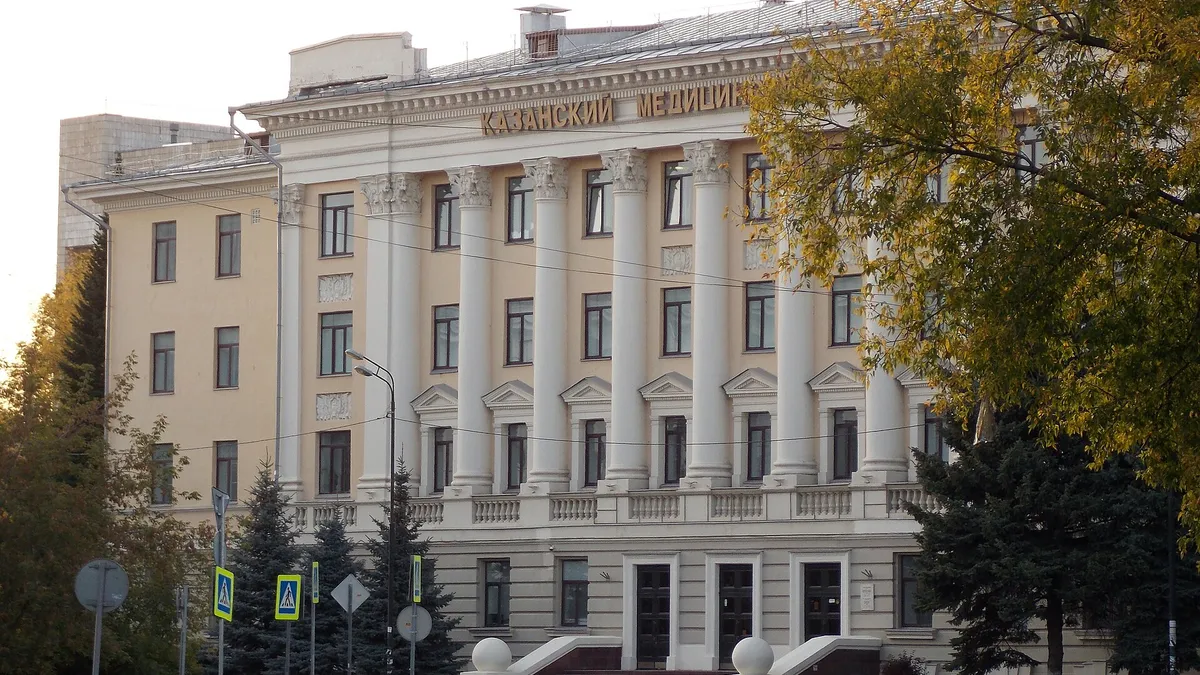
Wikipedia puts the student body at about 4,000, without a date. We found no published count of Indian students at KSMU, so we cannot tell you how large the Indian or Malayali group is. The FMGE reports give an indirect sign: 1,586 KSMU graduates sat the exam between 2022 and 2025, so Indian students are a regular part of the university. If a consultant quotes you a number of Indian students, ask which year it refers to and where it comes from. Some older sources call the institution the Kazan Medical Institute; make sure the website and address in your admission letter match those above.
Get the Kazan State Medical University fee structure
We send the current fee list, hostel details and the admission timeline for your intake.
Kazan State Medical University fees for Indian students
KSMU tuition is set in roubles. The university's English fee page lists a separate line, "General Medicine (English Medium)", for six years. The price list gives 475,000 roubles a year, which is the figure behind this page. That is the Kazan State Medical University fee for Indian students on the list we could read.
The dating needs care. The only version of the page we could read was an archived copy from September 2024, labelled 2023/24. A search excerpt of the live page shows the same 475,000 roubles for 2024/25. We could not read a 2026-27 price page, so the figure below is the latest we can document, not a promise for your intake. Agent websites quote higher numbers, discussed next.
KSMU fee structure 2024-25 (latest price page we could verify)
| Six years at today's fee (fees usually rise each year) | INR |
|---|---|
| Tuition, 6 years | ₹32.3 lakh |
| Hostel, 6 years | ₹0.9 lakh |
| Tuition and hostel, 6 years | ₹33.2 lakh |
In rupees, the KSMU tuition fee works out to about ₹5.4 lakh a year at today's exchange rate, and about ₹32 lakh over six years if the fee never rose. The six-year table above also adds the hostel fee. Russian universities usually raise fees, and the university says the hostel typically rises 5–7% a year, so keep a reserve of 10–20% for fee increases and for the rouble-rupee rate. Tuition is paid to the university, per year or per semester; ask which.
| Cost item | What we know for KSMU |
|---|---|
| Tuition, General Medicine (English Medium) | 475,000 RUB a year, about ₹5.4 lakh (official page, labelled 2023/24) |
| Tuition, Dentistry (English) | 495,100 RUB a year, about ₹5.6 lakh (same page) |
| Hostel | 13,920 RUB a year, about ₹15,800 (same page) |
| Medical insurance | 6,000 RUB a year, about ₹6,800 (same page) |
| Preparatory course | 142,636 RUB a year, about ₹1.6 lakh (same page) |
| Food, transport, phone | Not published; ask senior students |
| Flights | Kerala to Moscow via a Gulf hub or Delhi, then a domestic flight or train to Kazan |
Other numbers circulate. One consultancy page lists 517,000 roubles (about ₹5.9 lakh) for later years, and an aggregator lists 600,000 roubles for 2026-27 (about ₹6.8 lakh). Both are agent figures that we could not verify, and they may include services or a different programme. Ask KSMU's international office for the current fee list for your batch and for a signed contract. The office email shown in a search excerpt is [email protected]; check it on the official site before you write.
Compare KSMU with other universities on the MBBS in Russia fees page. Its tuition is above the cheapest universities in our list and well below Kazan Federal University. The fee page does not say whether the English-medium fee is fixed for all six years or indexed yearly, so ask for that in writing. For a Kerala family the useful comparison is with private MBBS fees in Kerala: ask each Kerala college for its current fee list and compare the total for the full course, including hostel, travel and the FMGE preparation year that most Russian graduates need.
Living cost in Kazan
Beyond tuition and hostel, a student's monthly budget in Kazan is made up of food (cooked in the hostel kitchen or bought outside), a mobile plan and internet, local transport, study material, and warm clothing in the first year. We have no verified monthly figure for Kazan, so we do not give one. Ask three or four senior Indian students at KSMU what they really spend in a month before you fix the family budget; it depends most on how often a student eats out.
Hostel and hostel fees at Kazan State Medical University
The same fee page lists the hostel at 13,920 roubles a year, about ₹15,800 at the Central Bank of Russia rate, or a little over ₹1,300 a month. That looks low to an Indian family, but residences at Russian state universities are subsidised and their fees are usually a small fraction of tuition. Still ask the international office whether the figure covers twelve months or only the academic year, which room type it is for (shared rooms of two to four students are usual in Russian residences), and whether foreign students pay the same rate. The page also says the hostel fee typically rises 5–7% a year.
The real cost of living in a residence is food, not rent. Most students cook in shared kitchens on each floor, so ask whether the kitchen has hobs and a fridge for each room or is shared by the whole floor, and whether rice cookers and induction plates are allowed in the rooms.
Families often ask about the girls hostel at Kazan State Medical University and its fees. We found nothing published about separate girls' residences. Russian university residences are usually mixed buildings with separate rooms or floors, so ask how rooms are allocated, whether female students are placed together, who guards the entrance, and whether the residence has a kitchen. Also ask for photos or a video tour of the actual rooms the university will give you; stock images on agent sites are not the residence.
NEET cut-off and eligibility
We found no KSMU-specific NEET cut-off, and the university does not publish a minimum above the national one. What you need is the NEET-UG qualifying score for your category, because without it an Indian graduate cannot sit FMGE:
- NEET-UG: qualified, result valid for three years. In NEET-UG 2026 the qualifying score was 213 out of 720 for general and EWS, 194 for general PwBD and 177 for SC, ST and OBC (the 3 May exam was cancelled after a paper leak and re-held on 21 June 2026; the result came on 16 July 2026). In 2025 it was 144, 127 and 113.
- Class 12: Physics, Chemistry, Biology and English, with at least 50% in PCB (40% for reserved categories).
- Age: 17 by 31 December of the admission year.
Whether KSMU holds an entrance exam or interview for foreign applicants is not stated on the pages we could read, so ask exactly how admission is decided: on documents and NEET alone, or with a test in biology and chemistry. There is no published acceptance rate. The real filter is FMGE after six years, so a student with a weak NEET score should think hard about the exam ahead. See the full eligibility and documents list.
Check your eligibility for Kazan State Medical University
Send your NEET score and Class 12 marks; we tell you if you can apply this year.
Admission process and admission requirements at Kazan State Medical University
Apply online
Send scans of your passport, Class 10 and 12 mark sheets and NEET score card to the university's international office, directly or through us.
Admission letter and contract
The university checks the documents and issues an admission letter. Read the contract for the fee, the language of instruction, the hostel and the internship.
Invitation and visa
The university applies for your study invitation from the Russian migration authorities. With it you apply for the student visa; the nearest Russian consulate to Kerala is in Chennai. Documents are apostilled by the MEA, and Kerala students usually go through NORKA Roots.
Travel to Kazan
Fly to Moscow through a Gulf hub or Delhi, then on to Kazan. The university completes your migration registration after arrival.
Apply soon after NEET results, because the invitation and visa take several weeks. Ask KSMU for the exact intake date of the English-medium group. The general admission process page explains documents, apostille through NORKA Roots and the visa in detail.
Kazan State Medical University ranking and recognition
Families search for the Kazan State Medical University ranking, its world ranking, its QS ranking and its ranking in Russia. We found no ranking for KSMU that we can verify, so we do not quote one, and Russian national ratings change their methods often. Be careful with any agent page that gives a rank without naming the list and the year. Three things matter more for an Indian student:
- NMC rules. The degree is valid in India only if the course meets the NMC Foreign Medical Graduate Licentiate Regulations 2021: at least 54 months of study in English, a 12-month internship at the same university, and eligibility for a licence to practise in Russia. The NMC keeps no list of approved universities, so ask KSMU for written confirmation of each point. See NMC rules.
- World Directory of Medical Schools. We could not confirm KSMU's WDOMS listing, so check it yourself; an Indian graduate needs a degree from a recognised medical school.
- FMGE results, below, which show how its Indian graduates actually do. In our ranking by FMGE results KSMU is fifth of 24 universities with at least 300 candidates.
On English medium, be precise. The fee page lists "General Medicine (English Medium)" for six years as a separate line from the Russian-medium one. It does not say whether the clinical years, with patient contact, are also in English. KSMU does not state English for all six years on the page we read, so the student must get that in writing before paying.
FMGE passing percentage of Kazan State Medical University
NBEMS publishes FMGE results for every foreign university. KSMU graduates have passed above the Russian average in every one of the seven reports from 2020 to December 2025. In 2022, 41.0% passed against a Russian average of 26.0%; in 2023, 23.3% against 19.4%; in 2024, 30.7% against 29.5%. In June 2025, 21.4% passed against 18.1%, and in December 2025 32.0% against 30.9%. Over 2022–2025 combined, KSMU passed 30.5% of 1,586 candidates, against about 25% for Russia as a whole.
| Session | Appeared | Passed | Pass rate |
|---|---|---|---|
| December 2025 | 228 | 73 | 32.0% |
| June 2025 | 159 | 34 | 21.4% |
| 2024 | 436 | 134 | 30.7% |
| 2023 | 395 | 92 | 23.3% |
| 2022 | 368 | 151 | 41.0% |
| 2021 | 305 | 138 | 45.2% |
| 2020 | 233 | 55 | 23.6% |
The table shows two things. KSMU has beaten the Russian average every time, which is better than many universities can say. But the margin has narrowed: it was about 15 points in 2022 and only about one point in 2024 and December 2025. About two out of three KSMU candidates still failed in the latest session, so a student should not assume a pass. The older "MCI passing ratio" is the same thing: FMGE was run for the Medical Council of India before the NMC replaced it. Compare KSMU with every other university on the FMGE pass rate page.
Safety at Kazan State Medical University and in Kazan
Kazan is the capital of Tatarstan, on the Volga, and it is not in a border region or the North Caucasus. We know of no published incident involving Indian students at KSMU. That says nothing certain about the future, so take the same practical steps as anywhere in Russia:
- Check the current advisory at mea.gov.in before travel and again before each return to Russia.
- Register with the Indian Embassy in Moscow after arrival and keep its contact details, and those of the nearest consulate, in your phone.
- Ask the university what security the hostel has: entrance guard, entry control, cameras.
- Never accept a job or "contract" offer that involves the Russian military.
Get the Kazan State Medical University fee structure
We send the current fee list, hostel details and the admission timeline for your intake.
Life in Kazan for Kerala students
Kazan lies in the Volga region of Tatarstan and keeps Moscow time, which is 2.5 hours behind India. Kazan's average January temperature is about -10.0 °C and July about 20.5 °C (1991–2020 averages). We found no verified count of Indian students or list of Indian shops in Kazan, so ask current students. In the Russian interior, winters are cold, and students normally need a proper winter jacket, boots and thermal wear from the first year; ask senior students what they paid for them and where they bought them.
The best source on Indian food and student life is a student already there; reviews of KSMU on forums and social media are rarely dated, so treat them as leads, not facts. Before you commit, ask KSMU or us to connect you with current Indian students, preferably from Kerala, and ask them four things: how the hostel kitchen works, where they buy rice, spices and vegetables, how they spend a normal weekend, and how Russian language classes helped in the hospital. Keep in mind that clinical training means talking to Russian-speaking patients, so students who learn basic Russian in the first two years cope much better.
Kazan State Medical University location: distance to Moscow, nearest airport and how to get there from Kerala
Kazan State Medical University is at Butlerova str. 49 in Kazan, in the Volga region. The distance from Kazan to Moscow is about 720 km in a straight line. Students usually take a domestic flight from a Moscow airport to Kazan or travel overland by train. We have not verified the airport transfer or the train time, so ask the international office which airport and station it uses for student pickup and whether it sends someone to meet the first-year group.
From Kerala there is no direct flight to Russia. The usual route is Kochi, Thiruvananthapuram or Kozhikode to Moscow through Dubai, Sharjah, Abu Dhabi, Doha or Delhi, then onward to Kazan. Aeroflot flies Delhi–Moscow nonstop about daily. Kazan time is the same as Moscow, so a call to Kerala is a matter of remembering the 2.5-hour gap. Read more on the universities page and the map of all cities.
Scholarships, syllabus and courses
We found no KSMU scholarship that cuts tuition for Indian students as a rule, so plan to pay the full fee. The Russian government offers a limited number of state-funded places to foreign citizens each year through its quota programme, applied for on the official education-in-russia.com portal; competition is high and places in medicine are few. Be sceptical of an agent who promises a KSMU scholarship; ask for it in writing from the university.
The General Medicine syllabus follows the Russian federal standard for the six-year programme. A typical six-year plan looks like this; ask KSMU for its own curriculum before you sign:
| Years | Main subjects |
|---|---|
| 1–2 | Anatomy, histology, physiology, biochemistry, biology, Latin, Russian language |
| 3 | Pathology, pharmacology, microbiology, propaedeutics of internal diseases, general surgery |
| 4–5 | Internal medicine, surgery, obstetrics and gynaecology, pediatrics, neurology, infectious diseases, psychiatry |
| 6 | Clinical rotations in hospitals and the state final examinations |
The first years cover the basic sciences, then clinical subjects follow, with hospital practice in the senior years. Besides General Medicine, the fee page lists an English-language Dentistry line and a preparatory course, which is a language and foundation year before the main programme; ask whether it is needed for your group, since it adds about 142,636 roubles to the budget.
KSMU compared with similar universities
Families shortlisting KSMU usually compare it with universities at a similar fee or in the same city. The table uses first-year tuition and the combined FMGE pass rate for 2022–2025 from the NBEMS reports.
| University | City | Tuition per year | FMGE 2022–2025 |
|---|---|---|---|
| Kazan State Medical University | Kazan | ₹5.4 lakh | 30.5% |
| Kazan Federal University (Institute of Fundamental Medicine and Biology) | Kazan | ₹7.4 lakh | not ranked (under 300 candidates) |
| Privolzhsky Research Medical University | Nizhny Novgorod | ₹5.3 lakh | 36.9% |
| Smolensk State Medical University | Smolensk | ₹5.2 lakh (agent figure) | 35.4% |
At a similar fee, Privolzhsky and Smolensk have had better combined FMGE results than KSMU over the last four years, while KSMU is ahead of the Russian average and costs about ₹2 lakh a year less than Kazan Federal University. Smolensk's figure is an agent quote, so compare like with like once you have official lists from all three. Choose KSMU if you want a long-established medical school in a large city, with a published hostel fee, and the English-medium terms come in writing. See the full ranking by FMGE results.
After graduation: FMGE, internship and registration in Kerala
KSMU awards the Russian specialist diploma in General Medicine after six years. To practise in India, a graduate then needs to:
- Pass FMGE, held by NBEMS three times a year since 2026 (the NMC plans to replace it with NExT, with no date yet).
- Complete a 12-month supervised internship in India, as the NMC requires for foreign graduates.
- Register with the Travancore-Cochin Medical Council to practise in Kerala.
After registration, graduates can take NEET-PG for postgraduate seats in India like any other doctor. Practising in Russia is also possible but needs Russian accreditation and fluent Russian. Plan for a year or more between the KSMU diploma and the first salary in India. Many Kerala families also ask for FMGE coaching in Kerala during the final year; ask senior students how they prepared.
Pros and cons for a student from Kerala
| Pros | Cons |
|---|---|
| Public university founded in 1814, under the Ministry of Health | The fee page we could read is labelled 2023/24; current fee must be confirmed |
| FMGE results above the Russian average in all seven reports since 2020 | The margin over the Russian average has narrowed to about one point in 2024 and December 2025 |
| Tuition of about ₹5.4 lakh a year and a published hostel fee of 13,920 roubles | English medium for all six years is not stated; get it in writing |
| The fee page lists a separate English-medium General Medicine line | We found no count of Indian or Malayali students; ask for contacts |
| Hostel fee is published and low; the university says it rises 5–7% a year | No direct flight from Kerala; no verified WDOMS listing or world ranking |
| Kazan is a large city with its own international airport | Cold winters; budget for warm clothing in the first year |
Talk to us about Kazan State Medical University
We tell you honestly whether KSMU fits your NEET score, budget and expectations.
Kazan State Medical University: Frequently Asked Questions
What is the MBBS fee at Kazan State Medical University for Indian students?
The official English fee page gives 475,000 roubles a year for General Medicine (English Medium), about ₹5.4 lakh at the Central Bank of Russia rate of 15 October 2026. Over six years that is roughly ₹32 lakh in tuition if the fee did not change. The page we could read is labelled 2023/24, and agents quote higher figures, so confirm the current fee with the university.
What are the hostel facilities and hostel fees at Kazan State Medical University?
The fee page lists the hostel at 13,920 roubles a year, about ₹15,800, and says it typically rises 5–7% a year. Ask the international office in writing what the fee covers, what the rooms and kitchens are like, and how female students are housed. Medical insurance is listed separately at 6,000 roubles a year.
What NEET score is required for admission to Kazan State Medical University?
You need the NEET-UG qualifying score for your category: for the 2026 intake that is 213 out of 720 for general and EWS candidates and 177 for SC, ST and OBC (in 2025 it was 144 and 113; the marks rose in 2026 after the exam was re-held). We found no higher KSMU cut-off. Ask whether an entrance test or interview is also held.
Is Kazan State Medical University good for Indian students?
The numbers are favourable. KSMU graduates passed FMGE above the Russian average in every report since 2020, and 30.5% passed over 2022–2025 against about 25% for Russia. The margin has narrowed, most students still fail the exam in a given session, and English medium for all six years must be confirmed in writing.
Are there students from Kerala at Kazan State Medical University, and is Indian food available in Kazan?
We found no published count of Indian or Malayali students at KSMU, and no verified information on Indian food in Kazan. FMGE reports show that 1,586 KSMU graduates sat the exam in 2022–2025, so Indian students are present. Ask us or the university to connect you with current students from Kerala before you decide.
Sources: KSMU English fee page (kazangmu.ru/en/admissions/fee-structure, read through the Internet Archive, snapshot of September 2024, labelled 2023/24); Wikipedia infobox for founding year and student number; OpenStreetMap for address and coordinates; consultancy and aggregator fee listings (admistay.com, selectyouruniversity.com), marked as agent figures; NBEMS FMGE reports 2020–2025; NMC FMGL Regulations 2021; Central Bank of Russia rate of 15 October 2026.